
The Immaculate Conception
The Date Nine Months Before Mary was Born

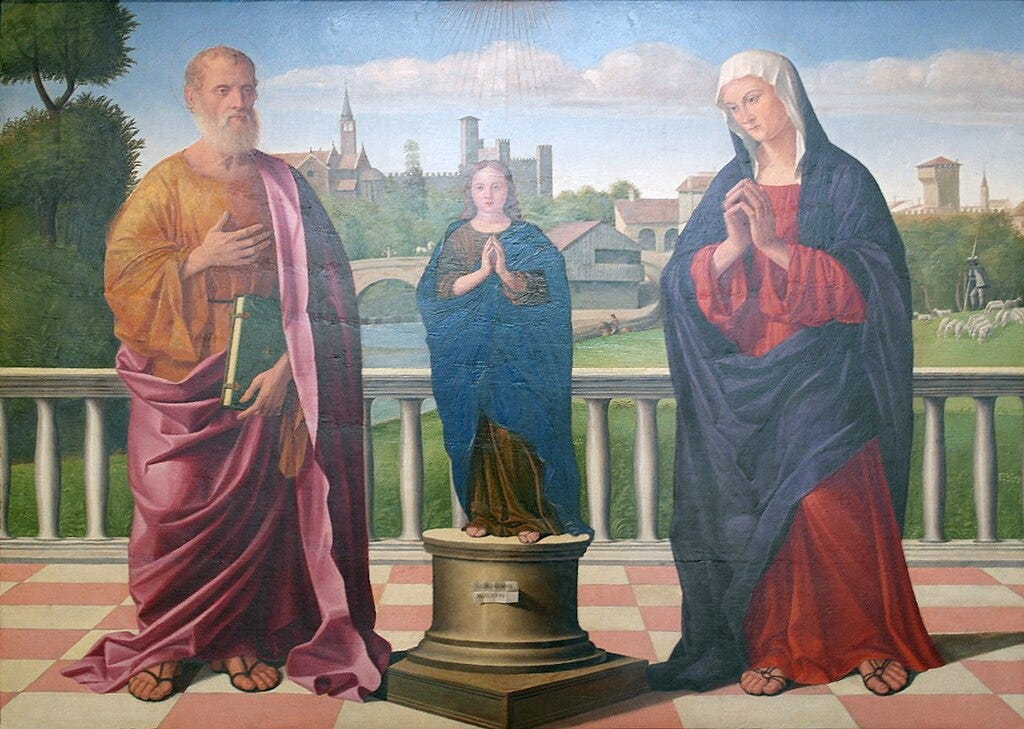
Girolamo Mocetto, Allegory of the Immaculate Conception, ca 1520 (Bonnefanten Museum, Maastricht): Mary with her parents, Joachim and Anna, as tradition has them named. You can see the rays of the Holy Spirit above her.
For those not Catholic, and even for most Catholics, the term “Immaculate Conception” is confusing, because its date occurs so near the time of Christ’s birth. And even our artwork does not help, because paintings labeled the Immaculate Conception often feature Mary holding her infant son. All I can say is that it is one of her titles and does not refer solely to the event we celebrate today.
There is one way to straighten it out: start with Jesus. Jesus’s birth is celebrated on December 25. I am not here to debate if that is the actual date. I don’t know, but the Nativity has been celebrated since at least the 4th Century in December or early January. So starting with December 25 as his birth, the Church assigns the date of his conception to nine months before, or March 25, also known as the Feast of the Annunciation (or the Announcing) by the Archangel Gabriel.
Note: This is not the Immaculate Conception. That term has to do with a unique privilege of the Blessed Mother, a privilege she received precisely because she was to conceive Jesus. The one she was to bear was to be the Christ, Son of God and Son of Mary. No person or thing touched by sin could touch God and live. Even to touch the Ark of the Covenant was forbidden, even to the Levites.
1 Chronicles 15:14–15
14 So the priests and the Levites consecrated themselves to bring up the ark of the Lord, the God of Israel. 15 And the Levites carried the ark of God on their shoulders nwith the poles, oas Moses had commanded according to the word of the Lord.
Numbers 4:15
15 And when Aaron and his sons have finished covering the sanctuary and all the furnishings of the sanctuary, as the camp sets out, after that mthe sons of Kohath [Levites] shall come to carry these, nbut they must not touch the holy things, lest they die. These are the things of the tent of meeting that the sons of Kohath are to carry.
The Ark of the Old Testament was being carried back to Jerusalem by David (2 Samuel 6) on an ox cart (foolishly), and when the oxen stumbled, a man named Uzzah reached out to steady the Ark and was struck dead. Now the Ark of the Covenant had holy things within it, the Staff of Aaron, and the Tablets, and they were so holy that to touch them was to die.
Mary, who was to bear the very Son of God should be immaculate, free from any stain of sin; I would argue she needed to be. So by virtue of a singular grace, Christ redeemed her, preventing the stain of original sin at the moment of her conception.
This is a mystery. It took the Church a millenium to work it out. God’s salvific act for Mary is even greater than for us. He saved her before she fell, like a man who is prevented from falling into a pit, rather than rescued from the pit after falling in it. Writing this, I see thorny issues that have to do with time, as viewed from our human perspective. But we know God is not so limited; he can act outside of time.
So we celebrate Mary’s Immaculate Conception, the grace that prepared her to be the Mother of God. As for the date? Well, the Church sets the date of her Immaculate Conception on December 8, and her birthday on September 8, nine months later.
We celebrate her Immaculate Conception to remember the reason for it, the utter and ineffable holiness of Jesus. Jesus, true God and true man. And there’s another mystery
The girls’ school held a beautiful Mass for this celebration of the Immaculate Conception. It was lovely. Thank you for this, Ann
I am not Catholic, I have no trouble believing Mary’s immaculate conception. I am not worried about specific dates, I believe God can do all things.